

Space-Based Solar — Sci-Fi to Reality (The 2025 Saga)

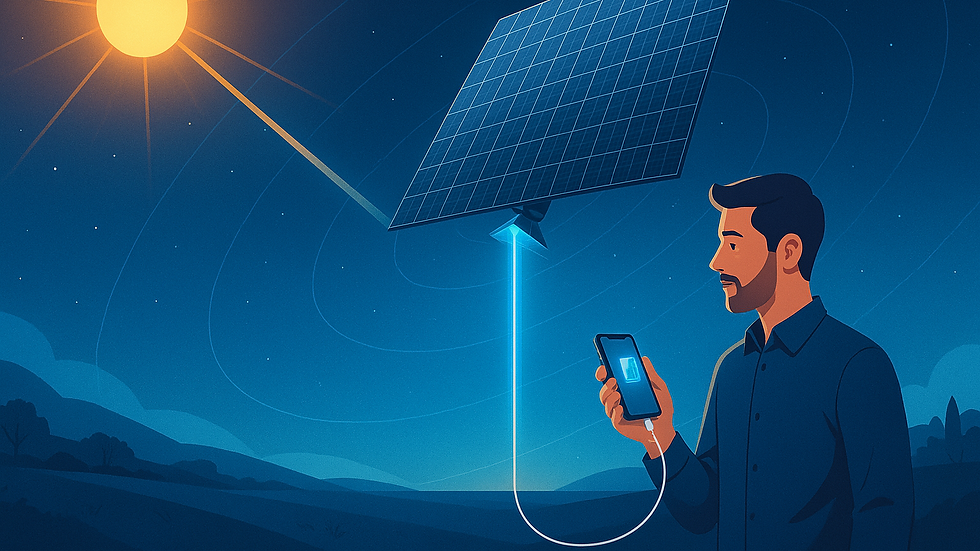
For decades, space-based solar power (SBSP) has lived in the same category as space elevators and lunar cities: compelling, but forever 20 years away.
But 2025 just broke that pattern.
Three developments — quiet, technical, unglamorous — have pushed SBSP from sci-fi daydream to a serious candidate for global energy infrastructure.
Here’s the shift unfolding above our heads:
Microwave Power Beaming Just Hit a Milestone We Thought Was a Decade Out
In April, an international team achieved stable, high-efficiency microwave power transmission over 1 km with minimal loss.
That’s the key bottleneck: Collect energy in space → Transmit it to Earth safely → Without massive dissipation
We finally have a pathway where the economics don’t implode on slide 7 of every feasibility deck.
Ultralight Solar Arrays Are Outperforming Their Own Roadmaps
Panel mass per watt has dropped 70% in 6 years. Manufacturers now have space-rated arrays that can unfold to the size of a football field yet weigh less than a compact car.
This matters because SBSP is a math problem: Less mass = cheaper launches = bigger arrays = more power = real viability.
The sensitivity curve is nonlinear… and it just bent in our favor.
Reusable Heavy-Lift Has Quietly Crushed the Launch Cost Barrier
Starship prototypes, New Glenn’s upcoming flights, and India’s emerging reusable launch stack have shifted baseline assumptions.
We’re entering a world where orbit becomes: “100x the payload for 1/10th the cost.”
SBSP moves from theoretical mega-project to something national governments and private coalitions can genuinely scope.
Why This Matters for Industry and Geopolitics
A working SBSP system offers what no terrestrial plant can:
24/7 clean energy
Generation unaffected by weather, seasons, or geography
Grid-scale base-load power, not intermittent supply
Countries are now asking the question that turns hype into strategy: “If we don’t build it, who will?”
Expect a decade of research races, pilot arrays, military demonstration missions, and partnerships between space agencies and major utilities.
The Bottom Line
Space-based solar power is no longer a moonshot. It’s a competitive frontier.
And as with every major turning point in space tech, the winners won’t be the loudest — they’ll be the ones already running the experiments few people are talking about.
The 2025 inflection point just opened a lane. Some players have already stepped into it.


